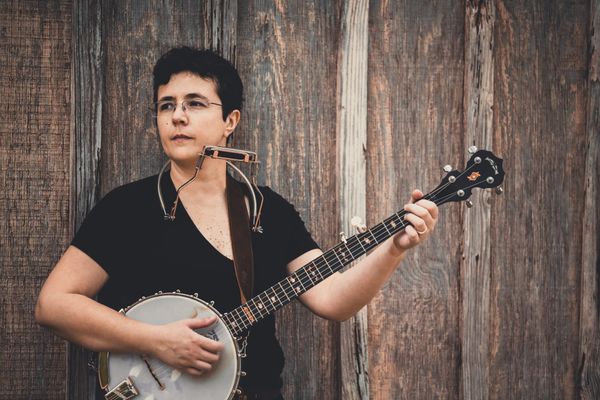
Claudia Gibson: Keep Writing Until the Good Songs Come
This Austin singer-songwriter has learned that life experience, creative freedom, and a willingness to write the bad songs can sometimes be the ingredients for the best ones.

This Austin singer-songwriter has learned that life experience, creative freedom, and a willingness to write the bad songs can sometimes be the ingredients for the best ones.
Claudia Gibson describes her music as “folk roots with wide branches,” and it is an especially fitting description for an artist whose musical life has never stayed neatly within one genre.
Based in Austin, Gibson’s influences and experiences stretch across folk, rock, Celtic music, soul, classical guitar, and beyond. But underneath all those branches is something much simpler: a fascination with what happens when a person takes something they have lived, felt, or wondered about and turns it into a song.
That fascination started early. As a kid, Gibson was drawn to musicians who wrote their own material. There was something almost magical about realizing the songs coming through the speakers began as someone’s thoughts and experiences.
“The idea of taking your own thoughts and experiences and turning them into music was fascinating,” she says. “And it seemed like a helluva lot of fun, too.”
So, at around 11 years old, she tried it herself. Her assessment of that first attempt is refreshingly unforgiving: “horrific.” But fortunately, she kept writing.
As Gibson developed as a musician, songwriting became an increasingly natural part of her creative life. She studied classical guitar and music composition in college, while simultaneously starting a rock band and writing original material.
It was an early indication of the musical range that would eventually define her work. Gibson was never particularly interested in choosing between the discipline of classical music and the freedom of a rock band. There was room for both.

When Life Interrupts the Song
Creative lives rarely follow a straight line. For Gibson, one of the biggest interruptions came when she became a mother. While raising three children, songwriting largely disappeared from her life for several years.
“I was just overwhelmed with raising three kids,” she says.
It could have become the end of the story. Instead, when Gibson eventually returned to songwriting, she discovered that the years away had given her something she did not have before.
“I realized my songs were a lot better because I had lived more and had a lot more to say.”
It reminds us that creative pauses are not necessarily empty spaces. Sometimes life is quietly accumulating the material that will eventually become the work. Gibson returned to songwriting with more experiences to draw from, more emotions to examine, and more stories to tell.
Write the Bad Song
Gibson has learned another lesson along the way, and it may be one of the most useful for anyone who makes things: Stop being afraid of making something bad.
“I think I have overcome the fear of writing a bad song,” Gibson says. “I just write them.”
A song doesn't have to become a masterpiece just because she started it. If it works, she keeps it. If it does not, she can put it aside, revisit it later, or pull pieces from it for another project or collaboration. The important thing is that she keeps creating.
Gibson is part of a songwriting group that helps reinforce that practice. Each month, members are given a prompt and expected to turn something in.
The song doesn't have to be brilliant. Sometimes the result is great. Sometimes, as Gibson puts it, it is “forgettable.” But the assignment forces the songwriter to do the one thing essential to eventually writing a good song: write.
“If you keep writing, the odds are in your favor that eventually you'll get a good one.”
It is a philosophy that replaces perfectionism with persistence. A forgettable song is not necessarily a failure. It may simply be part of the process that gets a songwriter to the one worth remembering.
Finding the Feeling We Share
For all the different influences running through Gibson’s music, her goal as a songwriter and performer ultimately comes back to connection. She writes about human experiences and emotions, searching for those moments that can feel intensely personal while also being nearly universal.
“When I perform, I am aiming to reach that commonality,” Gibson says, “the place where someone can say, ‘Yes, I've felt that too.’”
Connect with Claudia Gibson
Learn more about Claudia Gibson, listen to her music, watch videos, or get in touch through claudiagibson.com.